
The Snohomish County District Court Clerk
The Snohomish County District Court is the county's limited-jurisdiction court. The clerk function keeps and manages the court's case files, takes filings, collects fees, and gives the public access to records the court holds. These files are separate from Superior Court files. The Superior Court has its own clerk, Heidi Percy, and a different system for felony, family law, and probate matters.
District Court does not have an eFiling portal yet. To start or add to a case, you must file by postal mail, by fax, or in person at a division. There is no email filing. The court also does not answer questions by email. For routine help and recorded details, call the automated information line at 425-388-3331.
The court's District Court home page lists the case types it handles and points to its services. Leadership includes Presiding Judge Beth A. Fraser and Court Administrator Marianne Boggie. Because filing is paper-based, plan ahead. Allow mail time, and make sure forms are complete before you send them. An eFiling system is planned for September 2026, but until then the mail, fax, and in-person rules stand.
Note: District Court will not call or text you to demand payment for a warrant or unpaid balance, so treat such messages as a scam.
District Court Divisions in Snohomish County
The Snohomish County District Court runs through four divisions spread across the county. Each one has its own address, phone, and judges. You can file at any division, but it helps to use the one closest to you or the one tied to your case. The table below lists the divisions with their contacts and judicial officers.
| Division | Address | Phone | Judicial officers |
|---|---|---|---|
| Cascade (Arlington) | 415 Burke Ave., Arlington, WA 98223 | 360-435-7700 | Jennifer J. Rancourt; Rachelle D. Francis |
| Everett | 3000 Rockefeller Ave., M/S 508, Everett, WA 98201 | 425-262-2330 | Anthony E. Howard; Jennifer W. Millett; Nate L. Sugg, Commissioner |
| Evergreen (Monroe) | 14414 179th Ave SE, Monroe, WA 98272 | 360-805-6776 | Rick S. Leo; Patricia L. Lyon |
| South (Lynnwood) | 20520 68th Ave W, Lynnwood, WA 98036 | 425-744-6800 | Beth A. Fraser, Presiding Judge; Jeffrey D. Goodwin; Matthew D. Baldock |
You can view contacts, fax numbers, and staff roles on the District Court contacts page.
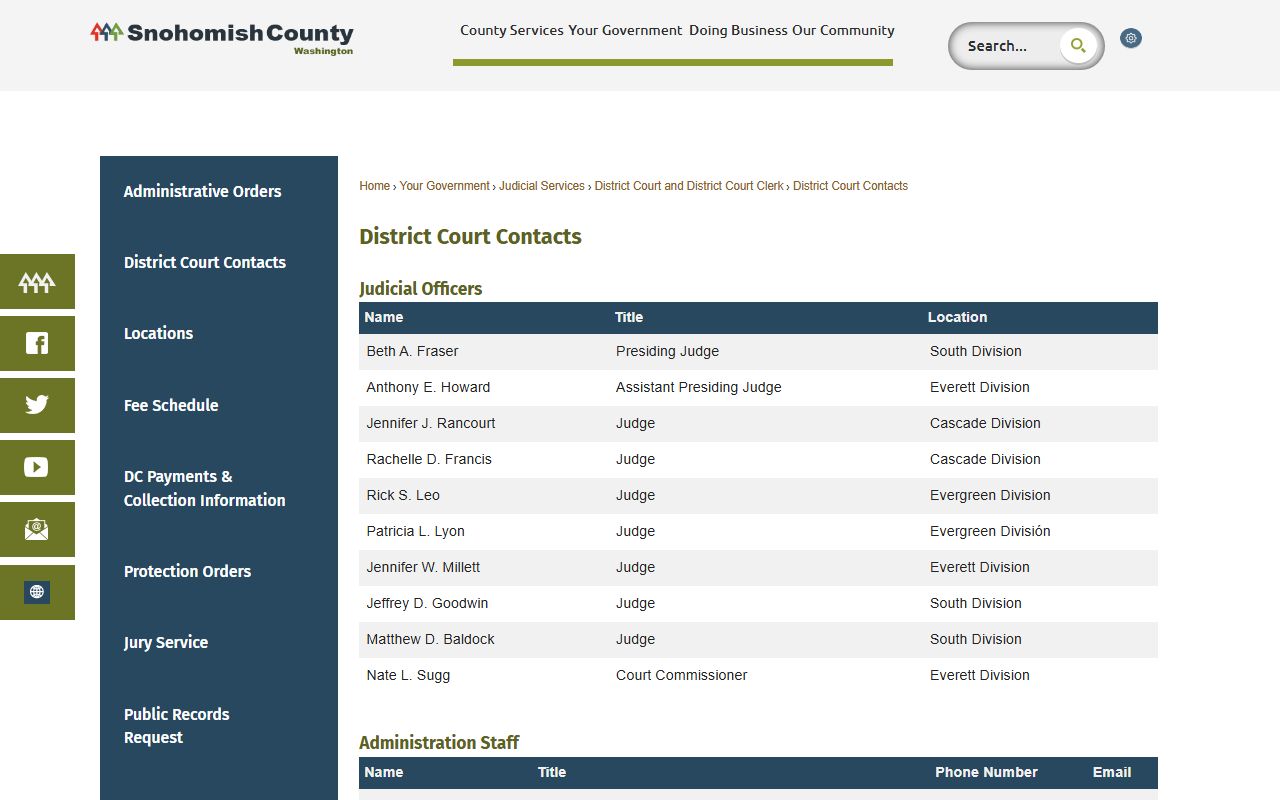
The contacts page is the fastest way to confirm a division phone or fax before you mail or visit. Names of judges and staff can change, so check the official page when accuracy matters.
Accessing District Court Records
District Court records are not handled under the Washington Public Records Act. The court states that records it keeps fall outside the PRA. Courts in Washington follow court rules instead. Two cases set this framework: Nast v. Michels and City of Federal Way v. Koenig. Court records are governed by GR 31. Administrative records are governed by GR 31.1. The split matters because the request path and timing can differ.
You can request records through several channels. The most common steps:
- Fill out the Request for Court and/or Administrative Records form at any division.
- Email the completed form, or send a written request, to SDC-PubDisclosure@snoco.org.
- Mail a letter to the Public Records Department at 3000 Rockefeller Ave., M/S 508, Everett, WA 98201.
Viewing court records in person is free. If a court record is available when you ask in person, you may view it then. If it is not ready, you may need an appointment once staff can pull it. Copying records with a smart phone must be done with help from staff. For administrative records, the court responds within five business days. It may give you the record, point you to a link, ask for clarification, give a time estimate, or deny the request. Do not assume every record takes five days; available court records can be viewed right away.
The county's public records request page explains the broader county process.
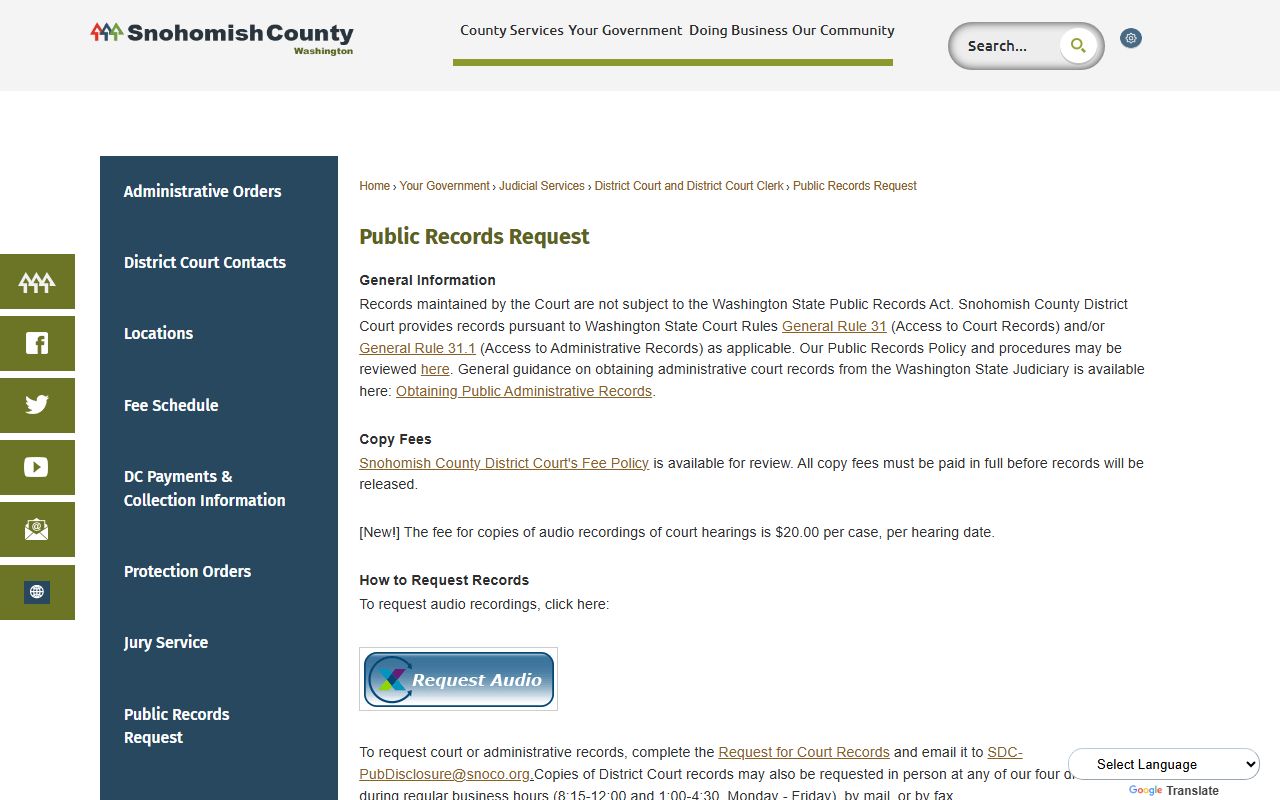
That page is a good starting point if you are unsure whether your request is a court record or an administrative one. When in doubt, describe the records you want as clearly as you can.
District Court Filing and Copy Fees
The District Court charges set fees to file cases and to get copies. Many of these fees come from state law, including RCW 3.62.060, which governs district court costs. The table below lists common filing and copy fees. Pay by an accepted method when you file. Fees can change, so confirm the current amount before you send payment.
| Filing or record type | Fee |
|---|---|
| Civil filing | $83 |
| Small claims filing | $50 |
| Name change | $262 |
| Civil jury demand | $125 |
| Writ of garnishment | $12 |
| Court record copies | $0.50 per page |
| Certified court record copies | $5 first page, $1 each added page |
| Court-hearing audio | $20 per hearing date |
You can review the full list on the court's fee schedule page.
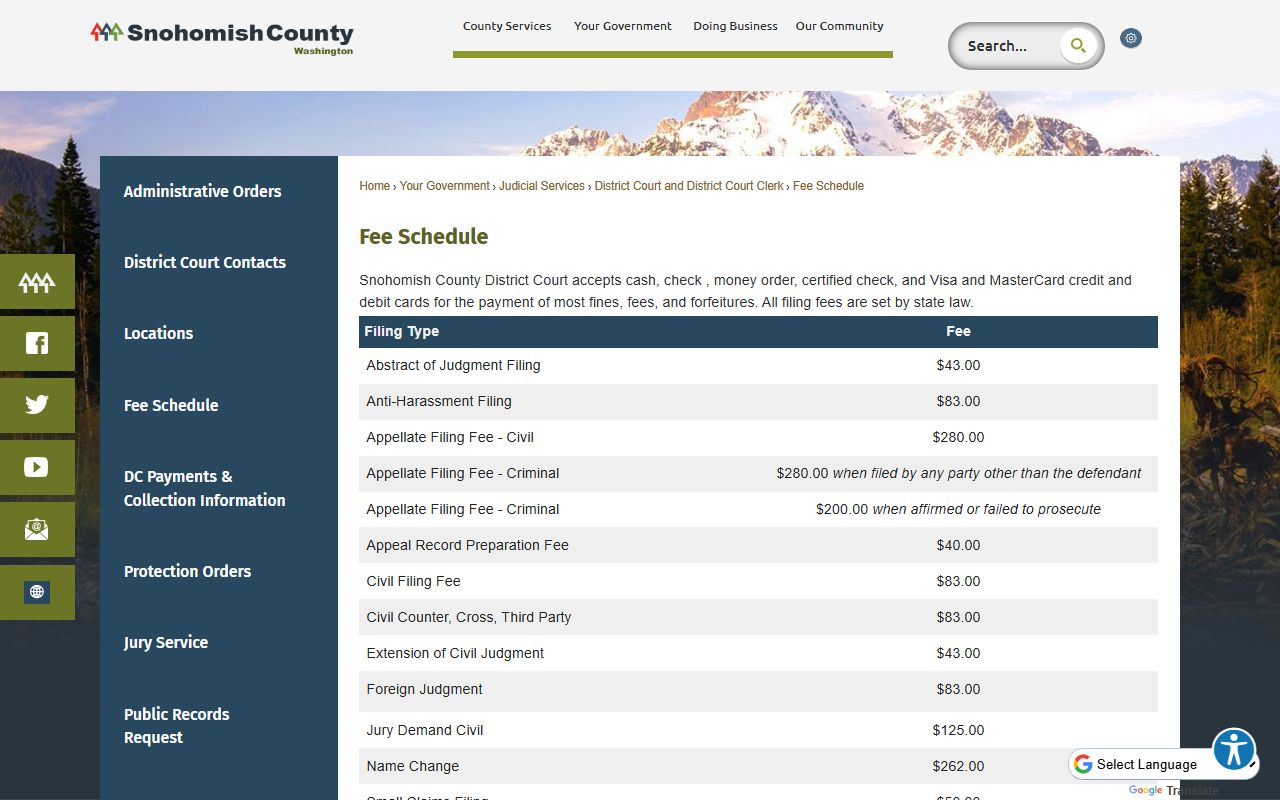
The fee schedule is the safest source for exact amounts. The legal basis for many district court fees sits in the state code, which you can read on the RCW 3.62.060 page.
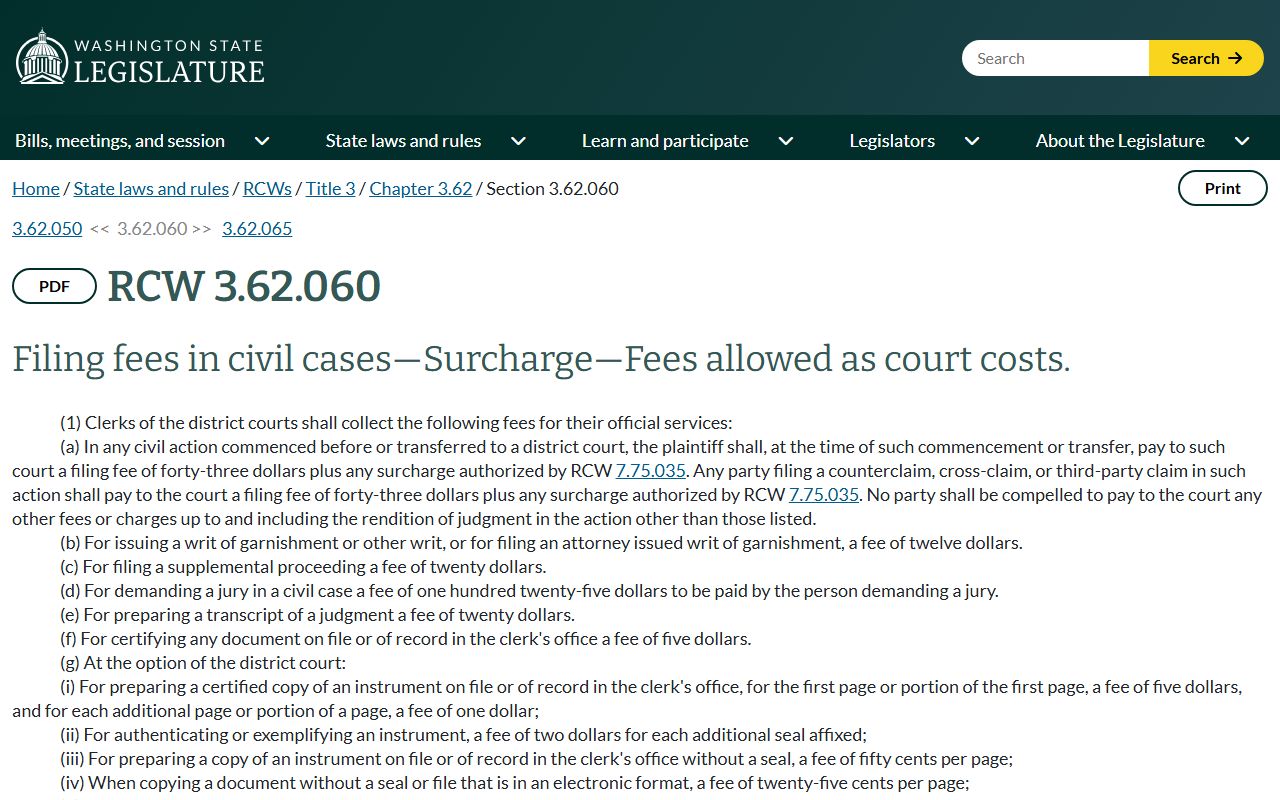
Reading the statute helps if you want to understand why a fee is set the way it is. The court applies these costs across all four divisions.
Cases the District Court Handles
The Snohomish County District Court hears a wide set of limited-jurisdiction matters. The court's home page lists the main case types. These are the records you are most likely to search for in District Court files.
- Infractions, such as non-criminal violations.
- Criminal traffic cases, like driving under the influence or driving with a suspended license.
- Misdemeanors and gross misdemeanors that are not traffic-related.
- Small claims, for lower-value money disputes.
- Name changes.
- Anti-harassment orders and domestic violence protection orders.
Felony cases, divorce, probate, and higher-value civil suits do not go here. Those belong to the Superior Court. If your matter is a traffic ticket or criminal traffic charge, the traffic court records page covers how those cases and tickets work in more detail.
Small claims and civil filings start with paper forms sent by mail, fax, or filed in person. Because there is no eFiling yet, keep copies of everything you submit. The court's resources menu also lists pages for civil cases, payment and collections, vehicle impound, and probation, which give task-specific help.
Note: name change cases carry the highest filing fee of the common types, so budget for that cost before you file.
District Court Warrants
Warrants tied to District Court cases are usually misdemeanor warrants or bench warrants for failure to appear. To ask about a misdemeanor warrant, call the District Court at 425-388-3331. Felony warrants are different and run through the Superior Court Clerk's Office at 425-388-3466. The county publishes an outstanding warrants list, but it is not a fully searchable text index, and the data can be delayed.
You can review the disclaimers and clearing steps on the outstanding warrants page.
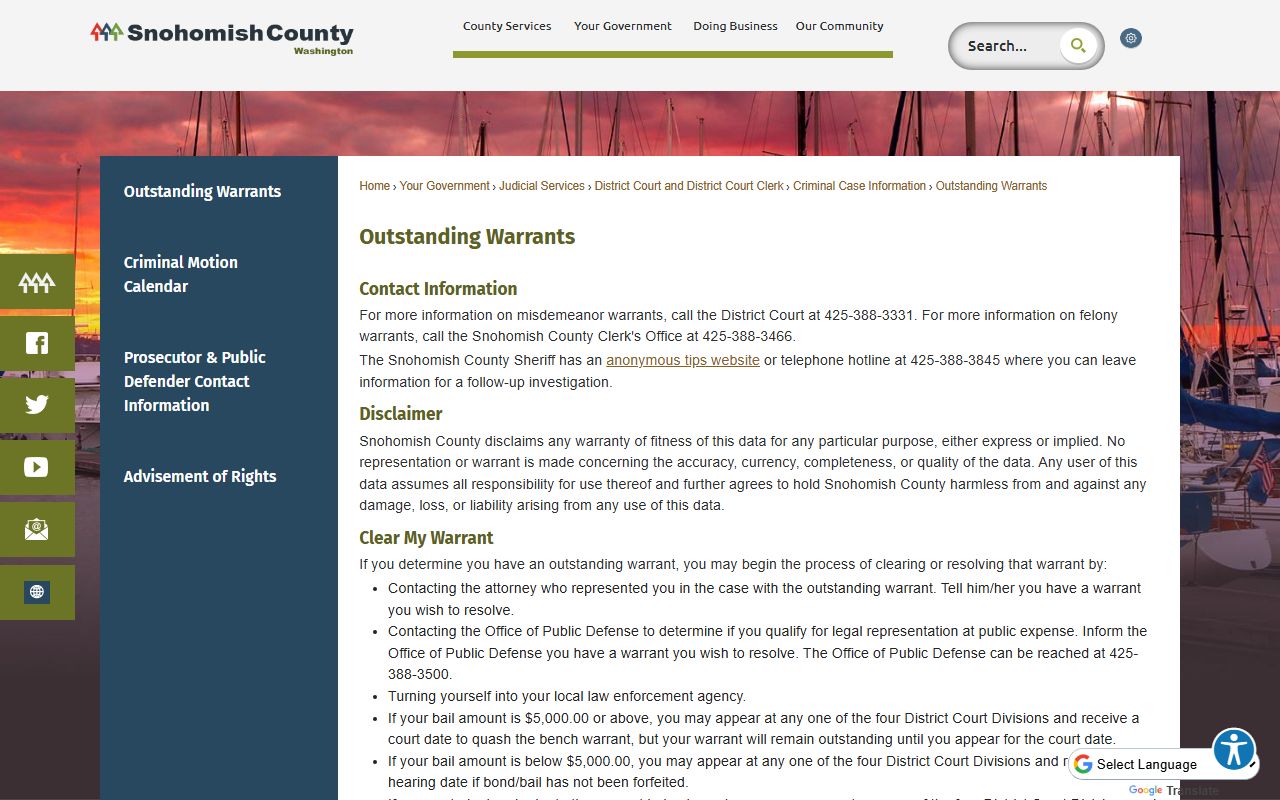
To resolve a District Court warrant, you can appear at any division to get a court date. If bail is $5,000 or above, you appear to receive a date to quash the bench warrant, but the warrant stays active until you show up for that court date. If bail is below $5,000, you can ask for a new hearing date if bond has not been forfeited. Bring valid proof of identity. The Office of Public Defense at 425-388-3500 may help if you qualify for a public defender. Our warrant records page walks through the full clearing process.
Note: the county does not guarantee that warrant data is current or complete, so verify any listing with the court or law enforcement before you act.
Mental Health Therapeutic Court
The District Court runs a Mental Health Therapeutic Court. The program is voluntary. It is built to help a person live a mentally stable, healthy, drug- and alcohol-free life. The court connects participants with treatment using a wraparound approach that pulls in mental health, substance abuse, and social service agencies.
To take part, a person must be an adult, 18 or older, and a Snohomish County resident. The process includes an updated mental health assessment, a substance use disorder assessment, and a team review. The team looks at whether the program fits the person's needs and whether they are a good match.
Records from therapeutic court cases are handled with care because they involve health and treatment details. Some material may be protected. The court keeps the program separate from the standard criminal calendar, though it sits within the District Court structure. People interested in the program usually learn about it through a defense attorney or court staff during a case.