
How to Request Snohomish County Public Records
The county handles agency records through a single online system. Before you submit anything, check the commonly requested records first. Many files are already posted, and that saves time on both ends.
The Snohomish County Public Records portal lets you browse those categories and then open a request for records that are not online. A request should name the records you want, give a date range, and include your contact details. Bot requests are not accepted, and vague requests may be sent back for clarification. The portal routes each request to the right custodian, since one office does not hold everything.
The county notes that its list is not complete. Some records stay offline because of confidentiality or sheer size. If no quick access method is shown, note the department that keeps the record and file a portal request to that office.
Here is the basic order for a county agency request.
- How to File a Public Records Request: Open the county Public Records portal and read the commonly requested records list.
- Confirm the record is an agency record, not a court case file.
- Identify the department that holds the record.
- Write a clear request: name the records, add a date range, and state the format you want.
- Add your name, email, and phone so a Public Records Specialist can reach you.
- Submit through the portal and save the confirmation.
- Watch for a clarification message; respond fast to keep the request moving.
- Pay any copy charge when the records are ready.
The county Public Records page is the starting point for most agency requests.
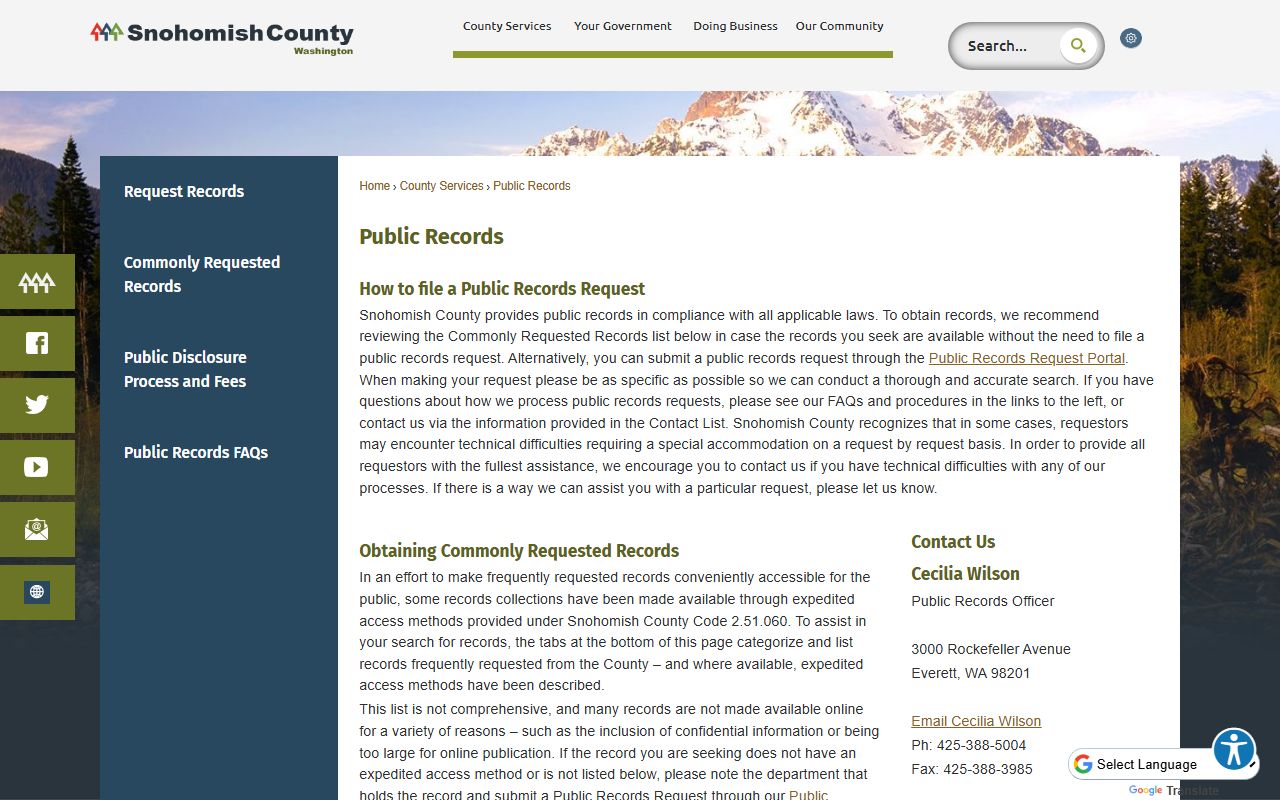
From there you can review posted records or open a new request to the department that keeps the file.
Note: Always check the commonly requested records list first, because a posted record can be downloaded right away without a formal request.
Public Records Act vs Court Records in Snohomish County
Washington splits records into two tracks, and the split decides where you ask. County agency records fall under the Public Records Act. Court case records do not.
The Public Records Act, RCW 42.56, governs records that county departments and offices prepare, own, use, or keep. That covers things like county department files, recorded documents, and business filings. Courts are treated differently. Washington case law holds that courts are not agencies under the Public Records Act. The Snohomish County District Court policy cites Nast v. Michels and City of Federal Way v. Koenig for that point.
So court case files run on court rules, not the PRA. Case records follow GR 31, and court administrative records follow GR 31.1. If you want a Superior Court case file, you go to the Clerk; you do not file a PRA request. The table below lines up the two paths.
| Feature | County agency records | Court records |
|---|---|---|
| Governing law | Public Records Act, RCW 42.56 | Court rules GR 31 and GR 31.1 |
| Where to ask | County Public Records portal | Clerk of the Superior Court or District Court |
| Examples | Recorded deeds, department reports, business filings | Civil, criminal, family law, probate case files |
| Are courts a PRA agency? | Yes, county departments are | No, per Nast v. Michels and City of Federal Way v. Koenig |
| Denial review | RCW 42.56.530 and 42.56.550 | GR 31.1 review for administrative records |
For case files and dockets, the right page is Snohomish County court records, which points to the Clerk and the Odyssey Portal. Use the portal for agency records only.
Recorded Documents in Snohomish County
Recorded documents are some of the most requested public records in the county. They are agency records, not court files, and the Auditor keeps them.
The Snohomish County Auditor Recording Division records and stores deeds, deeds of trust, reconveyances, mortgages, contracts, liens, leases, plats, surveys, and marriage licenses. Recording sits in the Robert Drewel Building at 3000 Rockefeller Avenue, First Floor, Everett, WA 98201. You can reach the office at 425-388-3483 or recording@snoco.gov, and hours are Monday through Friday, 9 a.m. to 5 p.m.
Recorded documents are public by statute. The county points to the recording statute for that rule.
State law makes the point clear. See RCW 65.04.140, which treats recorded documents as public records open to the public.
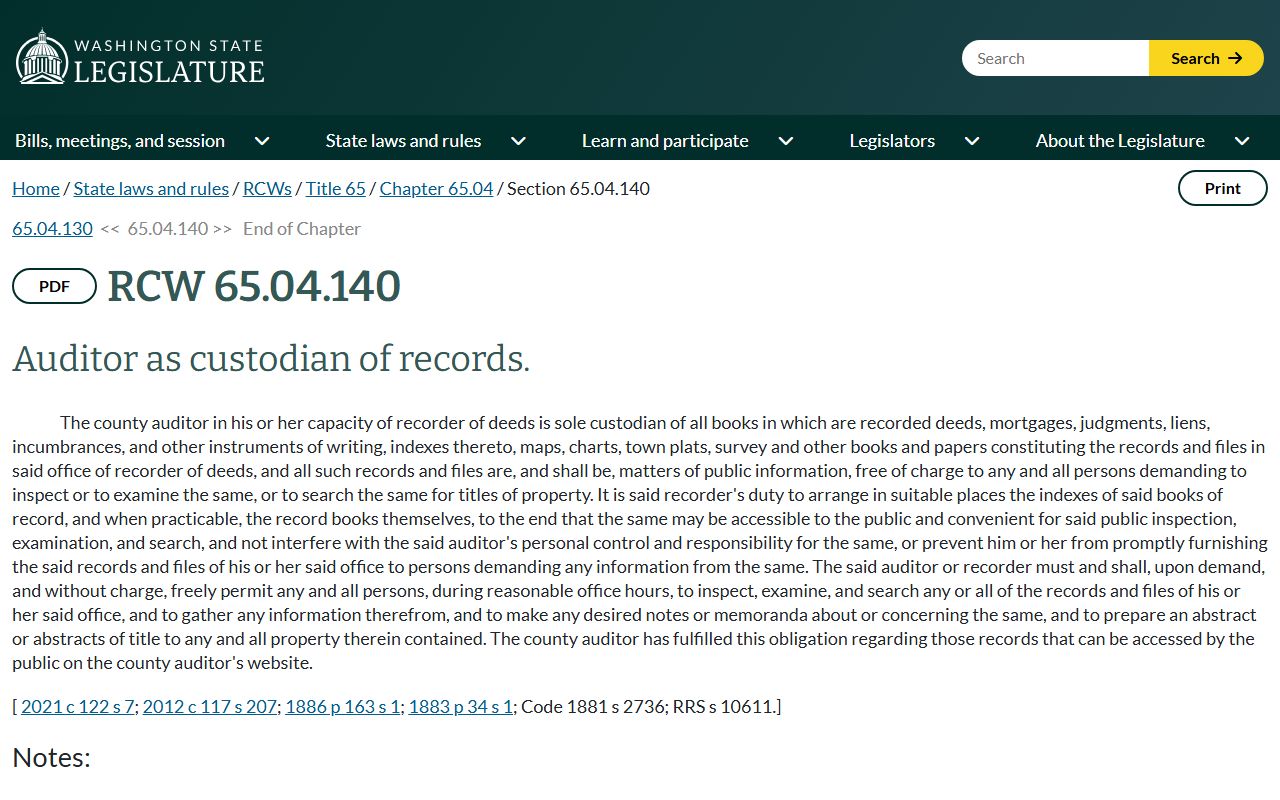
Because the statute deems these files public, anyone can search and request copies, subject to a few confidential exceptions.
Online search is changing. Beginning March 2, 2026, the Recording Division requires a free account to use the recorded documents search system. The account itself costs nothing; it just gates access to the online search tool. You can still view records in person at the office.
The Recording Division page is the hub for searching and ordering recorded documents.
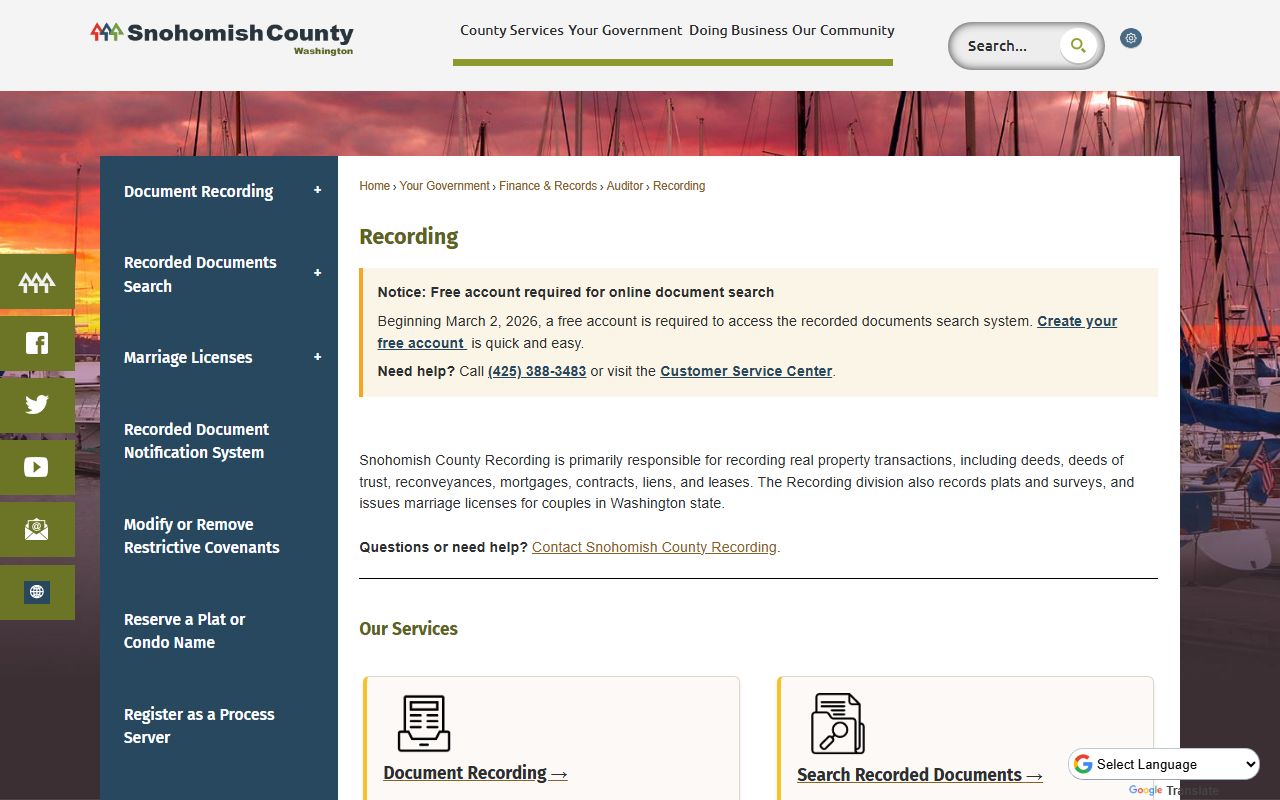
It also explains the free account notice and the services Recording handles for the public.
Note: Address Confidentiality Program participants can complete marriage applications privately, and those marriage records stay closed to public view.
Recorded Document Copy Fees
Copies of recorded documents carry set fees, and the Recording Division posts a fee schedule. Marriage records are part of that schedule, and the county lists clear per-copy charges for them.
The recorded document copy fees page shows the charges for unofficial copies, certified copies, marriage certificates, and postage. The table below reflects the fees the county documents.
| Item | Fee |
|---|---|
| Unofficial copy of certificate of marriage | $1 per copy |
| Certified copy of certificate of marriage | $3 per copy |
| Search fee for marriage record before 1976 | $8 per hour |
| Postage and handling, 1 to 10 copies | $1 |
| Postage and handling, 11 to 30 copies | $2 |
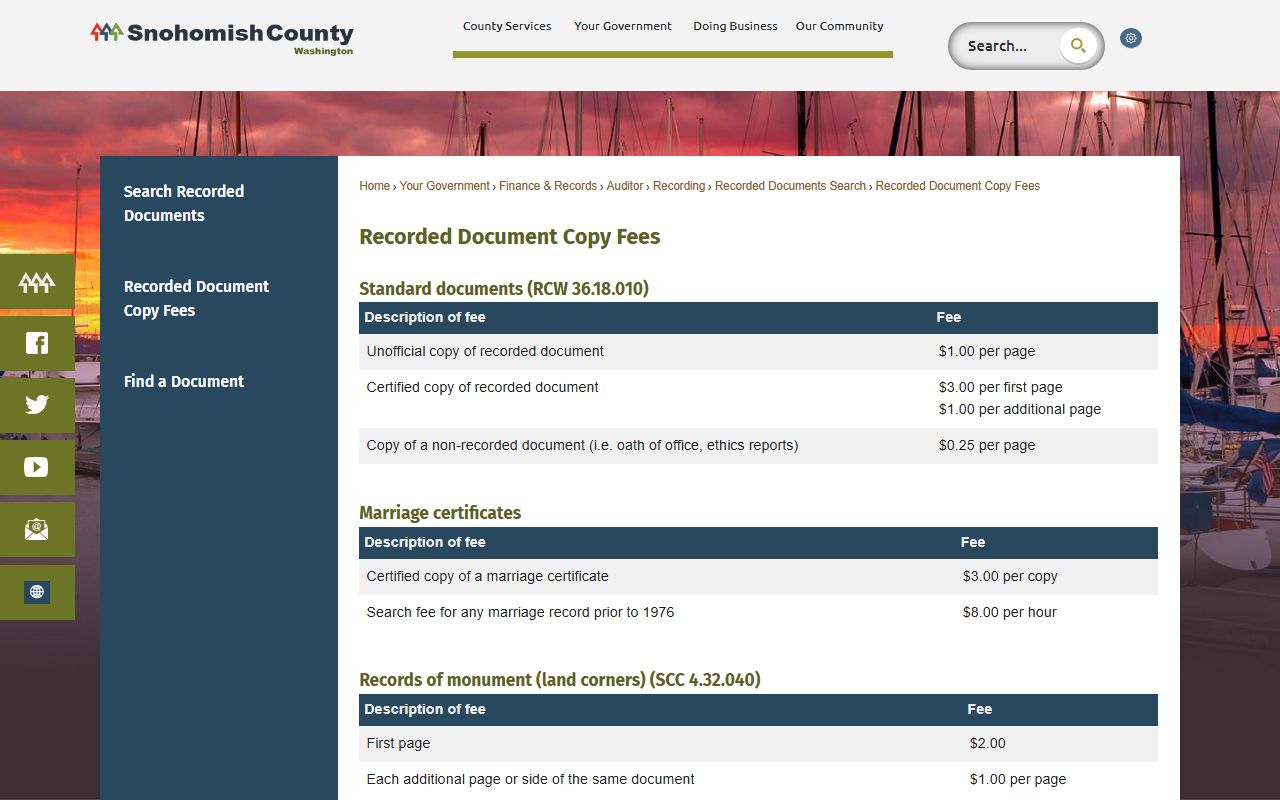
The fee page is the place to confirm current charges before you order copies of a recorded deed, lien, or other document.
Recording only holds marriage records that were licensed and recorded in Snohomish County. If the license came from another county, you have to contact that county. Certified marriage copies are not sent out on their own after a wedding; couples order them once the certificate is recorded. For copy charges on deeds and other recorded documents, confirm the amount with the Recording office, since fees can change with the posted schedule.
Fees and Response Timelines
Public records copy charges and response times come from the Public Records Act. The county follows the statute for both.
Copy charges for agency records are authorized by RCW 42.56.120. The county FAQ says its public records copy fees follow that statute. Court record fees are separate; those run under GR 31, GR 31.1, RCW 3.62.060, and RCW 36.18.020. So a copy fee for a county department file and a copy fee for a court case file may differ.
Response time is set by RCW 42.56.520, which requires a prompt response. Prompt does not always mean instant. A request may need more time when records are large, scattered across departments, or hard to identify. The county will give a reasonable time estimate when that happens.
Clarity matters. If a request is too broad or unclear, a Public Records Specialist may reach out to narrow it. The faster you answer, the faster the office can pull the records. Identifiable records are key here. Under RCW 42.56.080, a request must identify the records sought, so be specific and add a date range when you can.
Note: A prompt response under RCW 42.56.520 may be an acknowledgment with a time estimate, not the records themselves on day one.
Exemptions and Restricted Public Records
Not every record is open. The Public Records Act and other statutes shield certain categories, and the county reviews requests for those before release.
Law enforcement and investigative files often carry exemptions, and victim information may be withheld under RCW 42.56.240 and related statutes. Sealed and confidential court records are not public unless law, court rule, or a court order allows access; those must be requested in person at the Clerk with valid government photo identification.
Some categories are restricted by their own laws. The list below highlights common ones.
- Juvenile records
- Controlled by RCW 13.50 and juvenile court rules. Sealing runs under RCW 13.50.260, and these files are not ordinary adult public records.
- Adoption records
- Confidential under RCW 26.33.330.
- Jail records beyond the daily register
- Confidential under RCW 70.48.100, except to the inmate, by written permission, or by court order. The daily register can show name, booking dates, charges, offense dates, bail or bond, and the arresting agency.
- Family law confidential information
- GR 22 restricts personal identifiers, financial records, and certain reports in family law and guardianship matters.
- Will repository records before death
- Wills deposited before death are under seal; third parties need a court order or local rule basis to view them.
Mental health proceedings, including Joel's Law filings, may also be confidential. When a record is exempt in part, the county can withhold or redact the protected parts and release the rest.
Review and Appeal of a Denial
If the county denies a public records request, you have options. The Public Records Act builds in review steps.
A denial of agency records is addressed under RCW 42.56.530, which provides a review mechanism for denials. If you still disagree, you can ask a court to review the matter.
The judicial review path is set out in the statute below.
See RCW 42.56.550, which lets a person seek judicial review when an agency denies or limits access to public records.
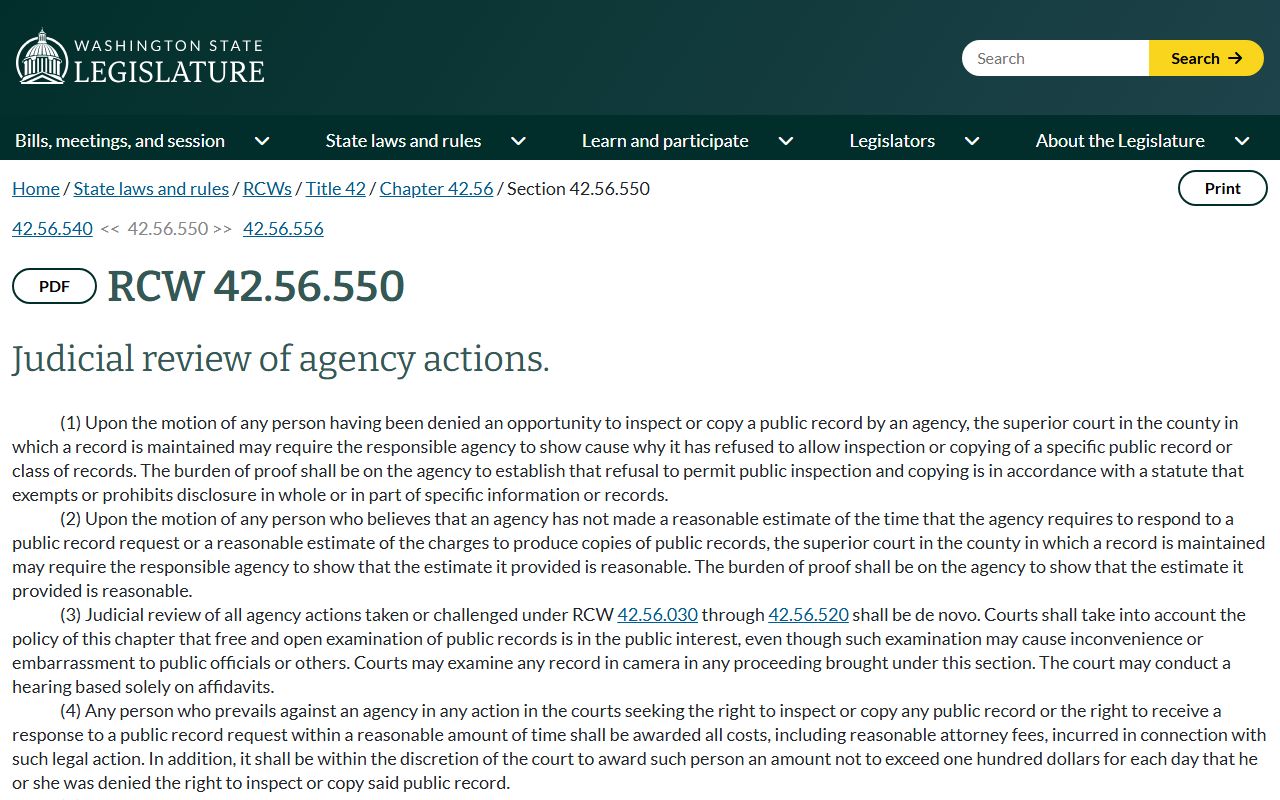
That statute is the route for a court to weigh an agency denial and decide whether the records should be released.
Court records work differently. A denial tied to a court administrative record is reviewed under GR 31.1, not under the Public Records Act. So the appeal path depends on the kind of record. Agency denials use the PRA review statutes; court administrative record denials use the court rule. Keep that split in mind before you file anything.
Public Records the County Keeps Beyond Courts
The county holds many records that have nothing to do with court cases. These agency records are the heart of most public records requests.
Recorded documents top the list: deeds, deeds of trust, liens, plats, surveys, and marriage licenses, all held by the Auditor Recording Division. The county also keeps business filings and a broad set of department records, from administrative reports to operational files. Each department is its own custodian, which is why the portal routes requests to the right office.
You can read more about the county on its history page for background on the offices that serve the area.
The county shares a brief overview on its Snohomish County history page.
That page helps put the county departments and their records in context.
One record the county does not keep is official criminal history. Washington State Patrol maintains criminal history record information through WSP WATCH, not the county. So a criminal background check is a WSP request, not a county public records request. Jail register data comes from the Sheriff and Corrections, and prosecution files come from the Prosecuting Attorney. Knowing which office holds what saves a lot of back and forth.