
How to Search Snohomish County Traffic Court Records
Most traffic cases in the county sit in a district or municipal court, and the fastest way to find one is the statewide case search. The Washington Courts Search Case Records portal covers district and municipal courts and offers Case Search, Person Search, Attorney Search, and Find My Court Date. The system updates within 24 hours. It also warns that the complete, official record must be verified with the court of record. Use it to confirm a court date or to find a citation tied to your name.
For infraction-specific help, the District Court keeps a dedicated page. Here is a simple step path to track and respond to a ticket.
- Read the citation and identify the court: a Snohomish County District Court division or a municipal court.
- Search the court date or case at Washington Courts, or contact the division directly.
- Decide your response: pay, request mitigation, request a contested hearing, ask for a payment plan, or request an eligible traffic-course or dismissal option.
- Submit your response by the court deadline and use official court forms.
- If you must appear, check whether remote or in-person is allowed for that hearing.
- After the case ends, check whether your DOL driving record changed. The court case and the driver abstract are separate files.
The lead-in for online research is the county's own District Court Traffic Infractions page, which lays out payment, mitigation, contested hearings, and payment plan options.
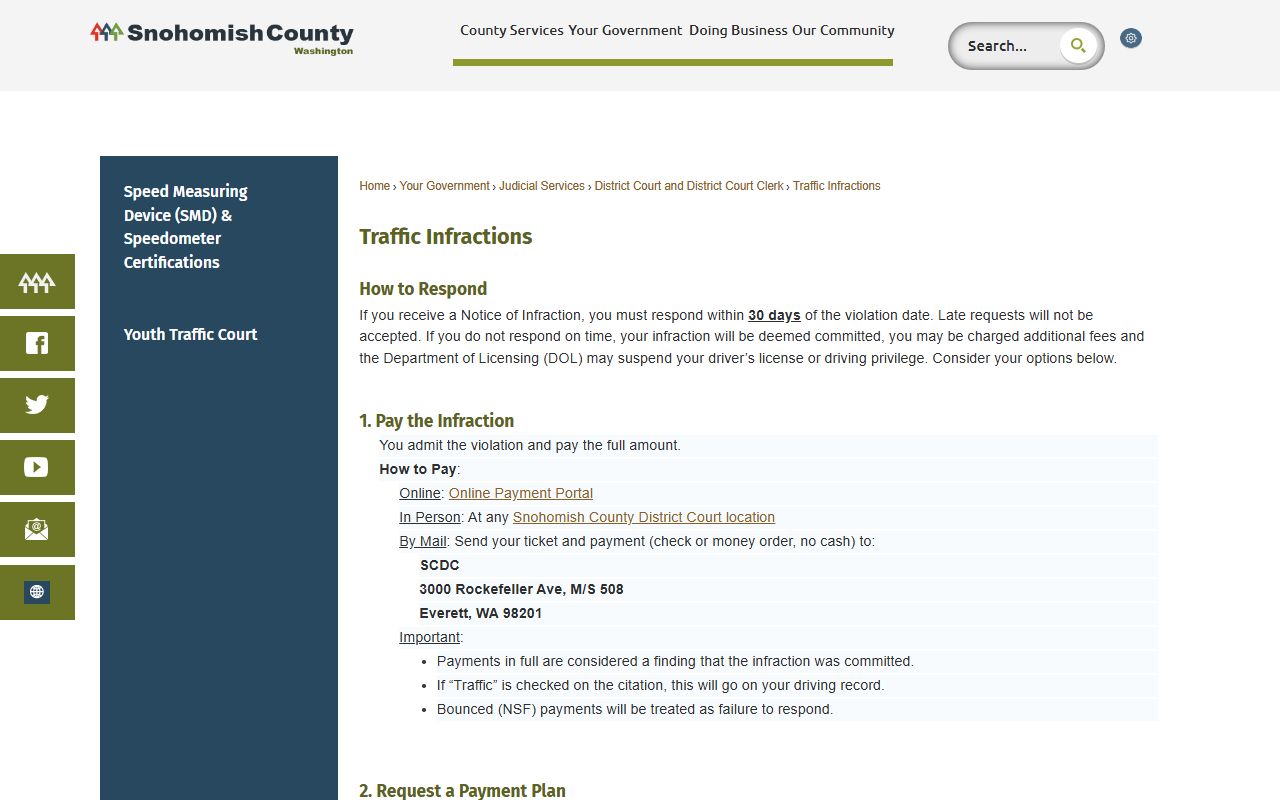
That page is the right starting point before you choose how to respond, since it links the official forms and payment methods for the District Court.
Which Courts Handle Traffic Cases in Snohomish County
Traffic cases split across two court levels. The Snohomish County District Court hears traffic infractions and criminal traffic matters across four divisions. Each division serves a part of the county, and a citation tells you which one holds your case. The District Court Clerk can confirm the division, case number, and court date when the citation is unclear.
Cities run their own municipal courts for tickets written inside city limits. Everett, Marysville, Lynnwood, and Mountlake Terrace each operate a municipal court that handles city traffic and ordinance matters. A ticket from a city police officer often lands in that city's court, not the District Court. The case search portal still finds both, so a Person Search can surface a municipal file even when you forget which court issued it.
Note: A city ticket and a county ticket can both show up under one name, so search by person to catch cases spread across more than one court.
Types of Traffic Cases on Record
Traffic records cover more than speeding tickets. The county sorts them into a few clear groups, and the response options differ by type.
- Traffic infractions. Non-criminal violations like speeding, failure to yield, or expired tabs. These carry a fine and can be paid, mitigated, or contested.
- Criminal traffic. Misdemeanor and gross misdemeanor matters such as driving while license suspended or reckless driving. These run as criminal cases, not simple fines.
- Parking and city ordinance. City-issued matters that route through a municipal court or city process rather than the District Court.
An infraction file may include the notice of infraction, citation number, violation date, statute or ordinance, court date, hearing request, the mitigation or contested outcome, the fine, any payment plan, a deferral or dismissal course, and a collections status if the fine went unpaid. Criminal traffic cases carry the heavier filings tied to a misdemeanor charge.
What Snohomish County Traffic Court Records Show
A traffic court record is built by the District or municipal court that handled the case. It ties the citation to a case number and tracks the case from filing to disposition. The table below maps the common fields and what each one tells you.
| Field | What It Shows |
|---|---|
| Citation number | The unique number on the ticket that links to the court case. |
| Violation date | The date the officer issued the citation. |
| Statute / ordinance | The law or city code the driver is alleged to have broken. |
| Court date | The scheduled hearing or response deadline. |
| Hearing choice | Whether the driver chose to pay, mitigate, or contest. |
| Disposition | The outcome: committed, dismissed, reduced, or found not committed. |
| Fine / payment | The amount owed and the payments made against it. |
| Deferral | Whether a deferral or traffic course was granted to keep the violation off the record. |
These fields stay with the court. The state driver record pulls some of the same facts but stores them in a separate file, which is why the two never match field for field.
Searching by Citation Number vs by Name
There are two main ways to pull a traffic case. The citation number is the most direct. It sits on the ticket and links straight to one case. If you have the ticket in hand, type the citation or case number into the case search and you land on the exact file.
A name search casts a wider net. Person Search on the Washington Courts portal returns every case tied to a name across district and municipal courts. That helps when the ticket is lost, when more than one violation exists, or when a court date is the only thing you need to confirm. The trade-off is that common names return many results, so a date of birth or court location narrows the list. Both methods reach the same record once you find the right case.
Paying or Contesting a Snohomish County Traffic Ticket
A driver has several ways to respond once a citation arrives. The District Court lets you pay online, in person, or by mail. You can also ask the court not to simply pay it and instead seek a different outcome. The options below cover the main paths.
- Pay the fine. Pay online, at the counter, or by mail. Paying admits the infraction.
- Mitigation hearing. Admit the violation but explain the circumstances and ask the judge to lower the fine.
- Contested hearing. Dispute the violation and ask the court to find it not committed.
- Signal Payment Plan. If you cannot pay in full within 30 days of the violation date, a Signal Payment Plan Application may let you pay over time.
- Resolve Without Going to Court. For certain options, "Resolve Your Infraction Without Going to Court" forms can be submitted at least five business days before the court date.
Each path has a deadline printed on the citation. Miss it and the court may enter the infraction and add it to collections, which can also trigger a DOL action against the license. Use the official District Court forms for every option.
Note: A payment plan only helps when the request reaches the court inside the 30-day window, so apply early rather than waiting for a notice.
Court Traffic Records vs State Driver Records
This is the gap that trips up most people. The court traffic record and the Washington driving record are two different files held by two different agencies. The court file lives with the District or municipal court. The driving record lives with the Washington Department of Licensing. The table compares them side by side.
| Feature | Court Traffic Record | State Driver Record (DOL) |
|---|---|---|
| Record source | District or municipal court that heard the case | Washington Department of Licensing |
| What's in it | Citation, case number, court date, hearing choice, disposition, fine | Violations, citations, convictions, departmental actions, and collisions |
| Where to access | Washington Courts case search or the court of record | DOL driving record copy, $15 |
| How to correct | Through the court that handled the case | Through the Department of Licensing |
To get the state file, request a DOL driving record. An online copy costs $15 and requires a License Express account, and the self-service online copy is open to Washington residents. A mail copy takes about 10 to 14 days. The court abstract does not update the instant a case ends, so check both files after a disposition.
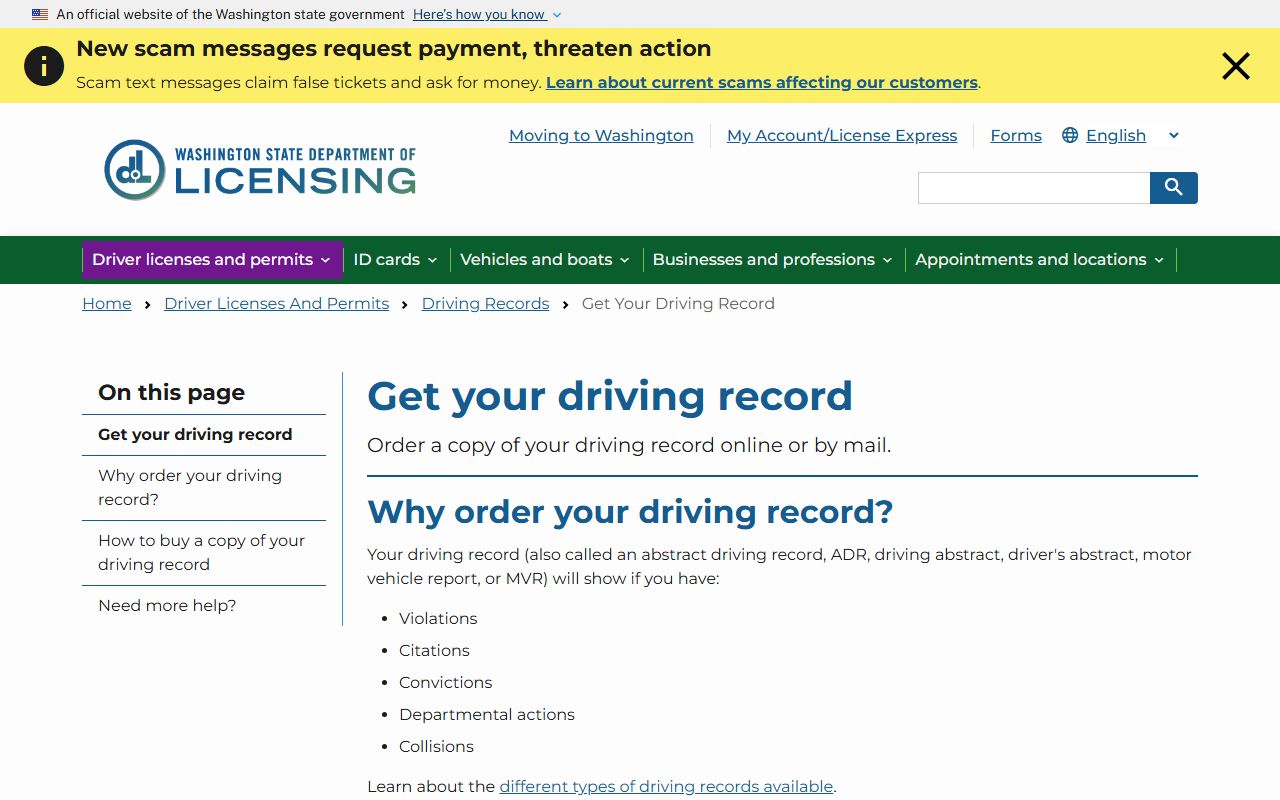
The DOL page walks through the copy options, fee, and the License Express login used for the online version of the driving record.
Washington Driving Record Fields
The DOL request itself has a short set of fields and choices. Knowing them ahead of time keeps the copy request from stalling. The table lists what the request involves.
| Field Label | Type | Required | Options / Format Notes |
|---|---|---|---|
| License Express login or create account | Account / login | Required for online self-copy | Washington resident required for the online self-copy. |
| Driving Record Request form | PDF / mail form | Required for mail | Available in English, Spanish, Russian, and more. |
| Payment | Payment | Required | $15 per copy. |
| Delivery | System / mail / in-person | n/a | Online record on the dashboard 24 hours after purchase; mail copy 10 to 14 days; driver licensing office purchase available. |
The online copy shows up on the License Express dashboard a day after purchase. A mail copy moves slower, so plan for nearly two weeks if you skip the online route.
CDL and Commercial Driver Records
Commercial drivers carry the same split between court files and the state record. A traffic case still moves through a District or municipal court, but the driver abstract that employers and regulators rely on comes from the Department of Licensing. The DOL maintains the commercial driver abstract along with the standard driving record. Because a CDL holder faces stricter rules, a single infraction can carry more weight on the state abstract than on the court file. Pull both when a commercial license is at stake.
DUI and DWI Cases
Driving under the influence is not a simple infraction. These cases route to criminal court as misdemeanor or gross misdemeanor matters, which means they carry the full set of criminal filings rather than a fine notice. A DUI case can appear in District Court or, in some matters, escalate further. For the criminal side of a driving case, see the county's criminal records resources, which cover how these charges are filed and tracked.
Deferred Adjudication and Defensive Driving
Some drivers can keep an infraction off the record. A deferral lets the court hold the violation in abeyance, and if the driver stays clean and meets any conditions, the infraction may be dismissed. The District Court traffic page outlines the deferral and traffic-course options that go with this path. A traffic course or dismissal option can apply to certain eligible infractions. These choices show up in the case file as a deferral or course entry, and a granted deferral can stop the violation from reaching the DOL driving record. Eligibility rules vary by violation and by how recently a prior deferral was used, so confirm with the court before you count on one.
Collision Reports
A crash report is its own kind of record, separate from both the court case and the DOL driving file. The Washington State Patrol runs an electronic system for these reports. The WSP WRECR portal handles electronic collision report requests and the OMVCR citizen collision reporting tool. A collision report documents the crash itself, while any ticket from that crash becomes a separate court case.
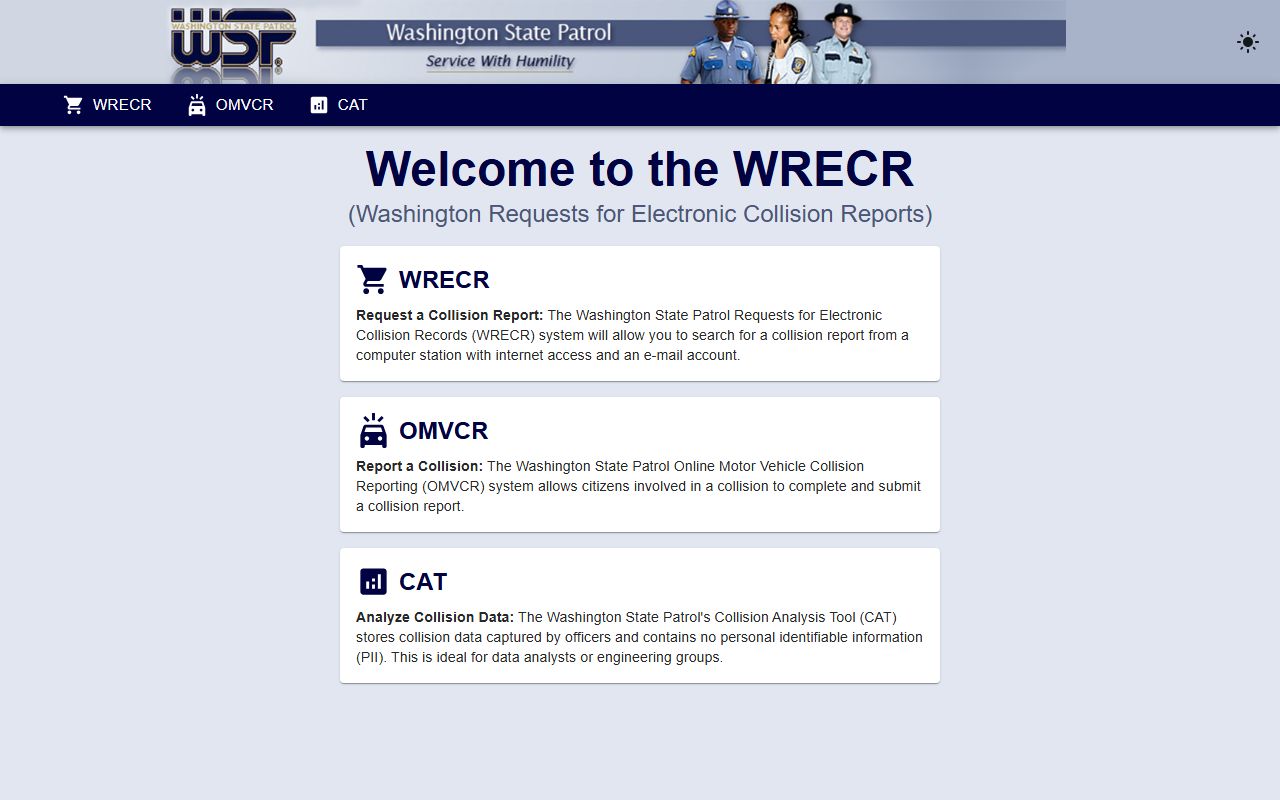
Use WRECR for the crash report and the court case search for any infraction or criminal traffic charge that followed the collision.
Fees for Traffic Record Copies
Copy costs depend on which file you want. The state driving record and the court copy are priced under different rules, so a clear list helps you budget the request.
| Record | Fee |
|---|---|
| DOL driving record copy | $15 per copy |
| District Court record copy | $0.50 per page |
| Certified court copy | $5 |
The case search portal is free to use, but a printed or certified copy from the court carries the per-page and certification fees above. The general court records overview and the Clerk of the Superior Court page explain copy requests for files held at the main campus.
Note: The free online case search is enough to read a traffic file, but a court hearing or an official use usually needs the certified copy that carries the $5 fee.