
Probate in Snohomish County Superior Court
Probate in Snohomish County runs through Superior Court. There is no separate probate court here. The Superior Court hears the case, and the County Clerk keeps the probate file. That split matters when you want a record. The court decides the matter. The Clerk holds and copies the paper.
When someone dies, their estate often must pass to heirs. When a court oversees that, it is called probate. The Clerk's Office handles the filings, wills, and the will repository. The lead-in below points to the official county source for probate and will information.
The Snohomish County Clerk probate page is the best first stop for fees, forms, and rules. See the Clerk's probate overview for current details.
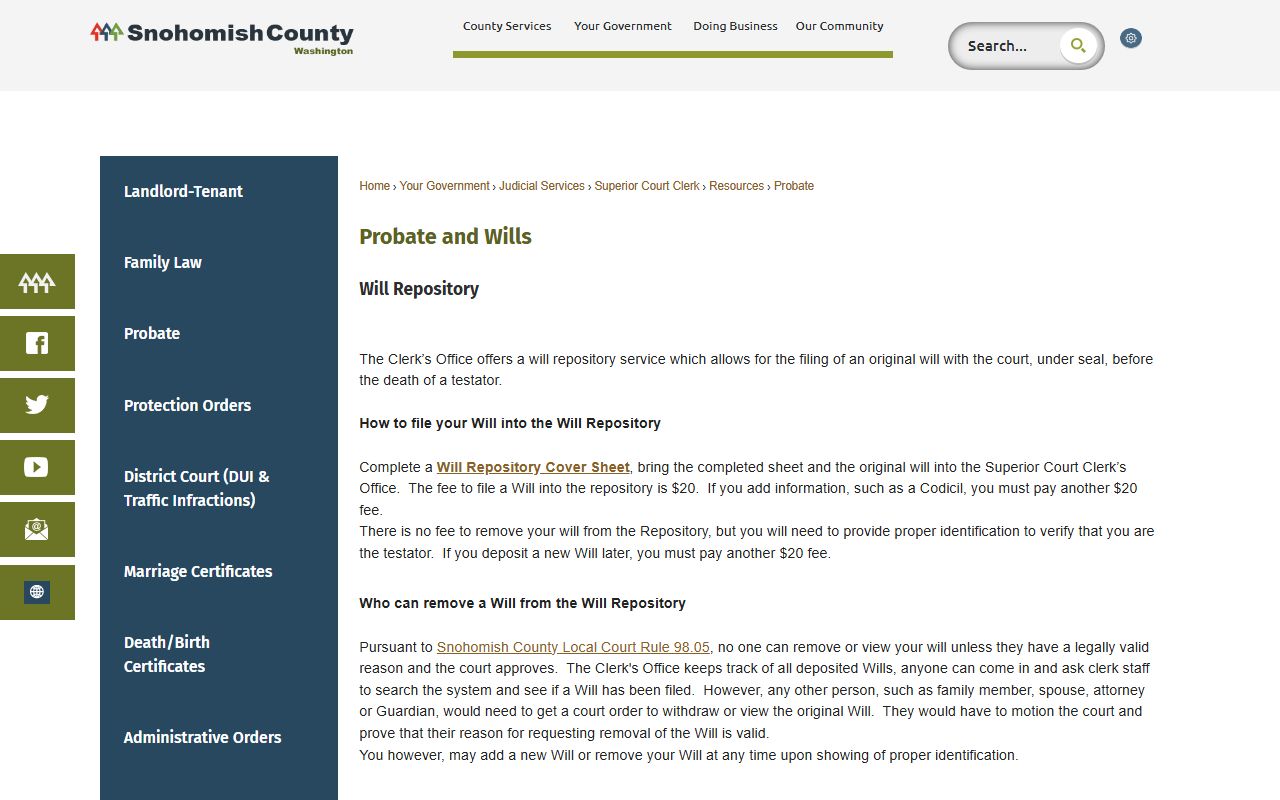
The page groups wills, the repository, and probate filings in one place so families can find the right step fast.
Snohomish County Superior Court Clerk
3000 Rockefeller Ave., M/S 605, Room M206
Everett, WA 98201
Phone: 425-388-3466
Hours: Mon-Fri 8:30 a.m. to 4:30 p.m.
The Clerk takes new probate filings, files wills, and pulls copies of case papers. Staff can tell you what to file. They cannot give legal advice. For a deeper look at the office, see the Clerk of the Superior Court page.
The Snohomish County Will Repository
The Clerk's Office runs a will repository. It lets a living person file an original will with the court under seal before death. The point is safekeeping. A will kept at the court is hard to lose, hard to change, and easy to find later.
To file a will, the testator completes a Will Repository Cover Sheet. Bring the cover sheet and the original will to the Superior Court Clerk's Office. Pay the $20 fee. The will then goes under seal. Adding a codicil or other information later costs another $20. If a new will is deposited at a later date, that filing also costs $20.
Removing your own will is free, but you must show proper photo identification. Under Snohomish County Local Court Rule 98.05, no one else can remove or view the sealed will unless they have a legally valid reason and court approval. A spouse, family member, attorney, or guardian must get a court order to withdraw or view the original.
Anyone may ask Clerk staff to search whether a will has been filed. That is allowed. But the will itself stays sealed while the testator is alive. After death, the will may become public. A person who holds a certified death certificate can ask the court to unseal it.
Note: Filing a will in the repository keeps it safe, but it does not by itself make the will legally valid.
Filing a Will After Death in Snohomish County
State law sets a clear duty. Anyone who has custody or control of an original will after the testator dies must file that will with the court. The deadline is 40 days. File it at the Superior Court Clerk's Office in the county where the person lived at death.
The fee to file a will after death is $20. Wills filed after death are public records. That means people can search for them and request copies. If a probate case is opened at the same time, the full filing fee of $290 applies instead.
Washington's rules on producing and probating wills sit in RCW Chapter 11.20. The lead-in link below opens the full text on the state legislature site.
The duty to file a will and the steps to admit it to probate appear in RCW 11.20 on the Washington legislature website.
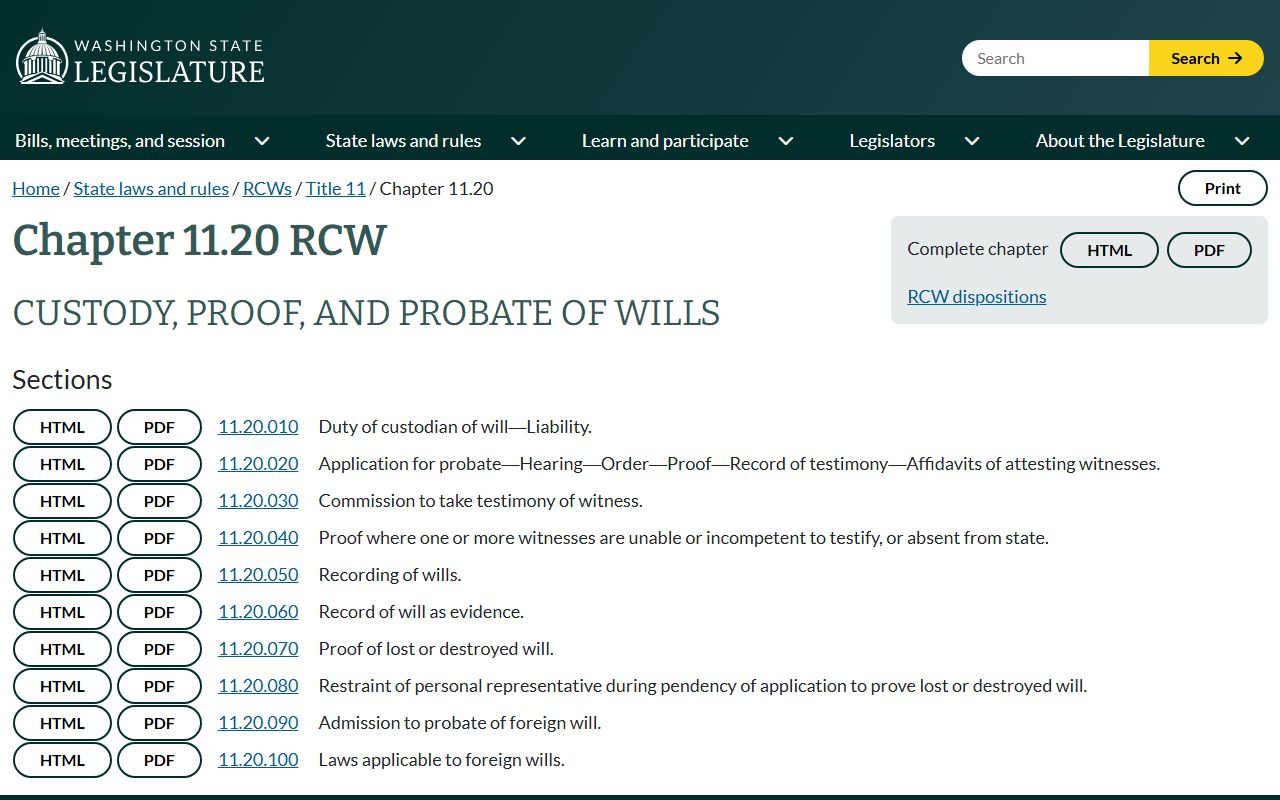
That chapter explains who must file, the time limits, and how a court admits a will to probate after a death.
Snohomish County Probate Fees
Probate costs depend on what you file. Some steps are cheap. Opening a full case is the big one. The table below lists the main fees the Clerk charges for wills and probate filings. Always confirm current amounts with the Clerk before you pay, since fee schedules can change.
| Item | Fee |
|---|---|
| Deposit will in repository | $20 |
| Add codicil or information to repository | $20 |
| Remove own will from repository | No fee; ID required |
| File will after death | $20 |
| Open probate case | $290 full filing fee |
| Counter petition, cross-claim, or third-party claim in probate or guardianship | $240 |
The $20 will fee covers only filing the will. It does not open a case. If heirs need a court to oversee the estate, the $290 fee opens probate. Later motions or claims by other parties may add the $240 charge. Copy fees and certification are separate.
How Probate Works
Probate follows a set path. Not every estate needs it. Small estates and certain transfers can skip a full case. When probate is needed, the steps below show the usual order, from the first will filing to the final order that closes the estate.
- Locate the original will and determine the decedent's county of residence at death.
- File the original will within 40 days if you have custody or control of it.
- Decide whether probate is necessary; a small estate or nonprobate transfer may apply under RCW 11.62.
- If probate is needed, file the petition and pay the full filing fee.
- Ask the court for appointment and letters; the court may appoint a personal representative.
- Give notice to heirs, beneficiaries, and creditors as required by law.
- Inventory the assets, resolve creditor claims and taxes, and sell or transfer property where authorized.
- File reports, accountings, and orders as the case requires.
- Distribute the estate to heirs and close the case.
The personal representative does most of the work. The court signs off at key points. Each filed step becomes part of the public probate record once the case is open, except for items the law restricts.
Searching Snohomish County Probate Records
Once a probate case is open, you can search it online. The state's Odyssey Portal holds Superior Court case information for Snohomish County. Search by case number or by the decedent's name. You can also filter by case type and narrow by file date range when those options show.
The portal shows case events and party names. Some documents are viewable online. Others are not. To get full copies of probate documents, you may need to request them from the Clerk, buy them through Washington State Digital Archives, use an Odyssey subscription, or view the file in person at the Clerk's Office.
Remember the limits. Will repository records filed before death are sealed and will not appear in a public search. Once a will is filed after death, or a probate case opens, the records become public and searchable. For broader access tools, see the Snohomish County court records page.
Note: Online portals can lag behind the paper file, so confirm anything urgent directly with the Clerk's Office before you act on it.
Small Estate Alternatives to Probate
Probate is not always required. Washington gives families simpler tools for smaller estates. When the estate value falls under the state limit, an heir may use a small estate affidavit to claim certain property without opening a court case. This saves time and the $290 filing fee.
These options live in RCW Chapter 11.62, the state's small estate and nonprobate transfer law. The chapter sets out who can use an affidavit, what property it covers, and the waiting period after death. The lead-in link below opens the full statute.
The small estate affidavit process and nonprobate transfer rules appear in RCW 11.62 on the Washington legislature website.
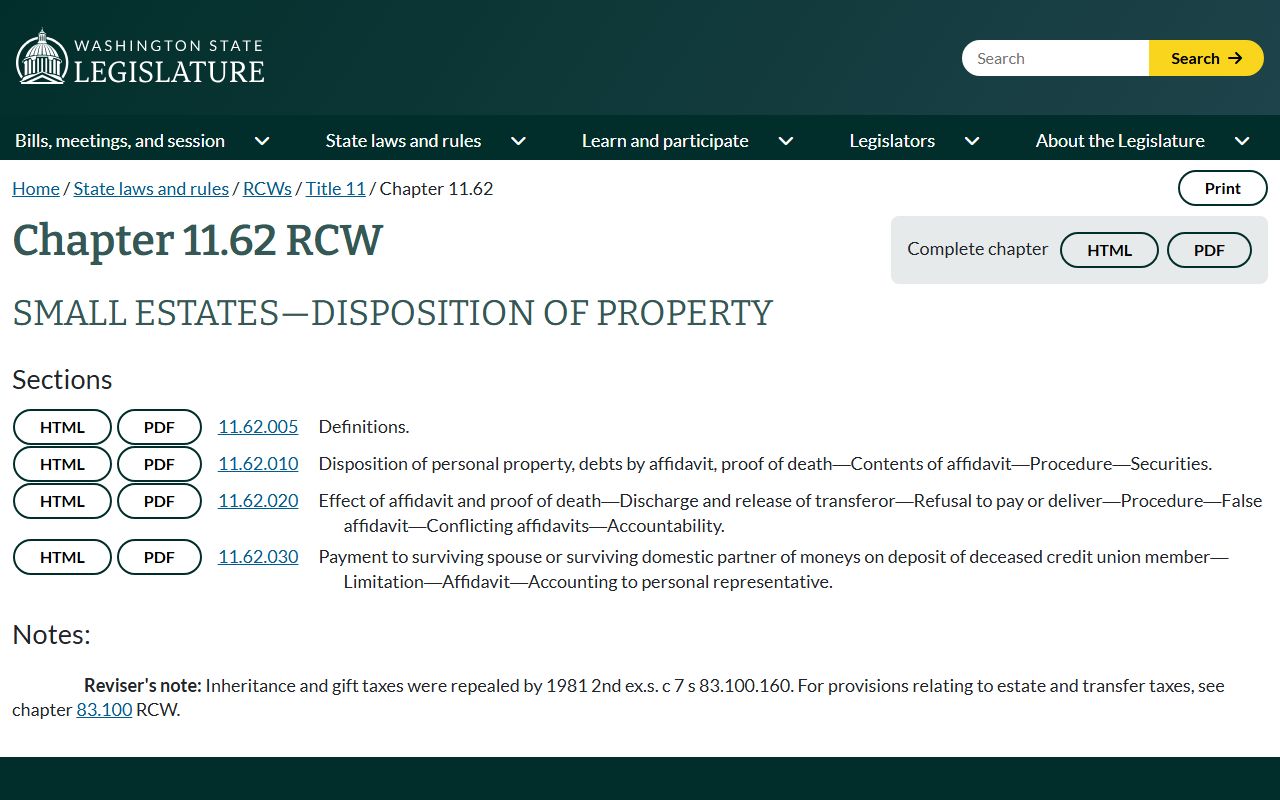
Some assets pass outside probate on their own. Joint accounts, payable-on-death accounts, and life insurance with a named beneficiary often transfer without a court. Talk to a lawyer if you are unsure which path fits the estate.
Probate Terms
Probate uses words that trip up many people. A short glossary helps. The terms below come up often in Snohomish County probate files and in talks with the Clerk's Office. Knowing them makes the records easier to read.
- Testator
- The person who makes a will. After death, that person's will may be filed with the court.
- Executor / Personal Representative
- The person named to manage the estate. Washington courts use the term personal representative. The court issues letters that grant the power to act.
- Intestate
- Dying without a valid will. State law then decides who inherits the estate.
- Guardianship
- A court setup where one person is given authority to make decisions for a minor or an adult who cannot manage their own affairs.
- Conservatorship
- A court arrangement focused on managing the property and finances of a person who needs that help.
Note: The Clerk's Office does not provide probate forms or legal advice, so use state form libraries or a lawyer for the documents you need.