
How to Look Up Snohomish County Jail Population Data
Population data for the Snohomish County jail lives in a few official places. The most current source is the live NWS Jail Register run by the Sheriff's Office Corrections Bureau. The Corrections Bureau and sheriff web pages add context on facility role and inmate services. There is no single dashboard that shows a clean daily total next to a rated capacity.
The register matters most, but it needs careful reading. At one inspection the register returned roughly 4,662 searchable subject records. That count is not the live jail population. The register list mixes current detainees with historical and prior records, plus people who are no longer in custody. To get closer to a true in-custody figure, a user must filter by the In Custody status or rely on an official jail report rather than the raw record total.
So the data splits into two layers. One layer is searchable and public. The other layer, the kind of summary report that states an average daily count, is not posted for general public use on the county pages reviewed.
- Live register
- Real-time, name-level records; includes past and present entries, so the total record count overstates current custody.
- Corrections Bureau pages
- Describe the jail's role and services; do not post a running population tally.
- Summary reports
- Would state average daily population; not located as a public county page.
Note: The register count is a list of records, not a head count, so it should never be quoted as the current Snohomish County jail population.
Snohomish County Jail Capacity Overview
The main custody site is the Snohomish County Corrections Bureau jail in Everett. It holds both pretrial detainees and people sentenced on local criminal matters. Two municipal jails, Lynnwood and Marysville, also appear inside the register through the housing facility filter. The table below lists each facility, its address, its role, and its rated capacity.
| Facility | Address | Role | Capacity |
|---|---|---|---|
| Snohomish County Main Jail / Corrections Bureau | 3025 Oakes Ave., Everett, WA 98201 | Adult county jail; pretrial and sentenced local custody | Not located in official sources |
| Lynnwood Municipal Jail | Linked from county jail register page | Municipal jail included in the NWS register | Not located in official county sources |
| Marysville Municipal Jail | Linked from county jail register page | Municipal jail included in the NWS register | Not located in official county sources |
The capacity column is blank for a reason. A rated or design capacity figure for the main jail was not found on the official county pages during research. The same is true for the two municipal jails shown in the register. Without a posted capacity number, no honest occupancy rate can be calculated here. People who need that figure should ask the Corrections Bureau directly or check sheriff budget materials.
Average Daily Population
Average daily population, often shortened to ADP, is the standard way jails report size over time. It smooths out day-to-day swings into one workable number. For Snohomish County, no official public ADP report was located during research.
That gap is worth stating plainly. The county does publish the live jail register, but it does not appear to publish a public ADP figure or a trend dashboard. So a reader who wants to know the typical daily count cannot pull it from a single county web page today.
What would source a real ADP number? Annual sheriff or Corrections Bureau budget reports usually carry it. County council or budget office documents may include detention staffing and bed-day totals that imply ADP. A public records request to the Sheriff's Office could also return the figure. Until one of those is in hand, any stated daily average for this jail should be treated as unverified. For name-level confirmation that a person is currently held, the better tool is the live inmate records lookup rather than a population estimate.
Demographic Breakdown
Many jail systems publish a breakdown of the population by race, sex, and age. That kind of table helps researchers and the public see who is held and spot disparities. For the Snohomish County jail, an official county demographic breakdown was not located during research.
No race, sex, or age distribution for the jail population is invented here. The county pages reviewed do not post one. The live register shows individual subjects, but a list of single records is not a demographic dataset and should not be read as one.
People who need population demographics have a few honest paths. They can file a public records request with the Sheriff's Office for an aggregate report. They can look to state and national jail studies for context, while keeping in mind those are not county figures. The key point holds across this whole topic: where the county has not published a number, it is better to say so than to guess. Related context on individual status and timing shows up on the released inmates page.
Pretrial vs Sentenced Population
A county jail is not one single group of people. It holds two broad classes at once, and the difference shapes how the population behaves. The Corrections Bureau provides secure detention for pretrial detainees and for those sentenced on criminal matters. Its stated mission stresses safe, secure, humane, and cost-effective detention under constitutional guidelines.
| Group | Why they are held | What drives their numbers |
|---|---|---|
| Pretrial detainees | Awaiting trial or hearings; not yet convicted in the current matter | Bail decisions, charge severity, court calendar speed |
| Sentenced inmates | Serving a sentence imposed on a criminal matter | Sentence length, sentencing volume, jail program rules |
Here is the limit. An official Snohomish County split showing the share that is pretrial versus sentenced was not located. National jail studies have long found that pretrial detainees make up a large part of local jail populations, but that is general context, not a county count. A reader should not pin a percentage on this jail without a sourced county report. Charge-level detail behind these two groups connects to broader criminal records that track the same cases.
Charge Types Observed in the Register
Browsing the live register, sample subject profiles show a charge table. The classes that appear include misdemeanor, gross misdemeanor, Felony B, and Felony C. The specific charges seen in those records range across several common categories.
- Controlled substance possession
- Stolen vehicle or stolen property
- Driving while license suspended
- Ignition interlock violations
- Attempting to elude
- Trespass and resisting arrest
- False or misleading statements
- Municipal code violations
One caveat carries real weight. A handful of records is not a statistical sample. The charges listed above describe what was visible in a few profiles, nothing more. They do not show the county-wide charge distribution, and they should not be used to claim that any one offense type dominates the jail. To see how a single charge moves through the courts, the warrant records page covers the related filings.
Note: Charge labels seen in a few register entries are illustrative only and must not be read as a measure of the whole Snohomish County jail population.
Offsite and Municipal Housing
Not everyone counted in the system sits inside the main Everett jail. The jail register includes an Offsite Housing option in its housing facility filter. That filter is a signal that some subjects are held in a location other than the central facility.
The county jail pages also point to two municipal jails, in Lynnwood and Marysville. Both appear within the NWS register, so a search may surface subjects tied to those municipal facilities alongside county detainees. This matters for any population question because the register can blend county and municipal housing under one search tool.
There is also a contract side to housing. Search results show that Snohomish County maintains interlocal jail housing rate documents. One example is a Skagit County interlocal agreement extension that lists 2024 figures for booking, a housing flat rate, and a video court fee. Those rate documents describe the cost of housing people across jurisdictions. They do not, however, supply a capacity number or an average daily population, so they cannot fill the gaps noted earlier on this topic.
National and State Context
When county figures are missing, the responsible move is to lean on high-authority sources for broad context, while flagging that they are not Snohomish County numbers. Two bodies are commonly cited for jail data: the U.S. Bureau of Justice Statistics (BJS) and the Vera Institute of Justice. BJS publishes recurring jail inmate reports at the national and state level. Vera tracks county and state incarceration trends.
The framing below is illustrative of how national and state context is structured, not a set of county figures.
| Source | What it covers | Snohomish County coverage |
|---|---|---|
| BJS jail reports | National and state jail population and rate trends | No standalone county breakdown cited here |
| Vera Institute | County and state incarceration trends over time | Use for context; verify any county figure at the source |
No specific rate or count is reproduced from these sources here, because doing so without the exact published figure in hand would risk error. The takeaway is simple. National and state jail data exist and are reliable for broad framing. A county-level demographic or trend table for this jail was not located, so that gap is flagged rather than filled with a guess.
Jail Operations and Services
Population is shaped in part by how the jail runs day to day. Visitation, mail, money, and property all follow set rules that affect detainees and the people who support them. Snohomish County Corrections does not offer contact social visiting. Family and friends must register online to video visit, schedule in advance, and match the inmate's availability. The inmate tells visitors when free time exists; staff will not share that schedule. Social visits run a maximum of 30 minutes.
The visitation rules and lobby hours are explained on the county's jail visitation page.
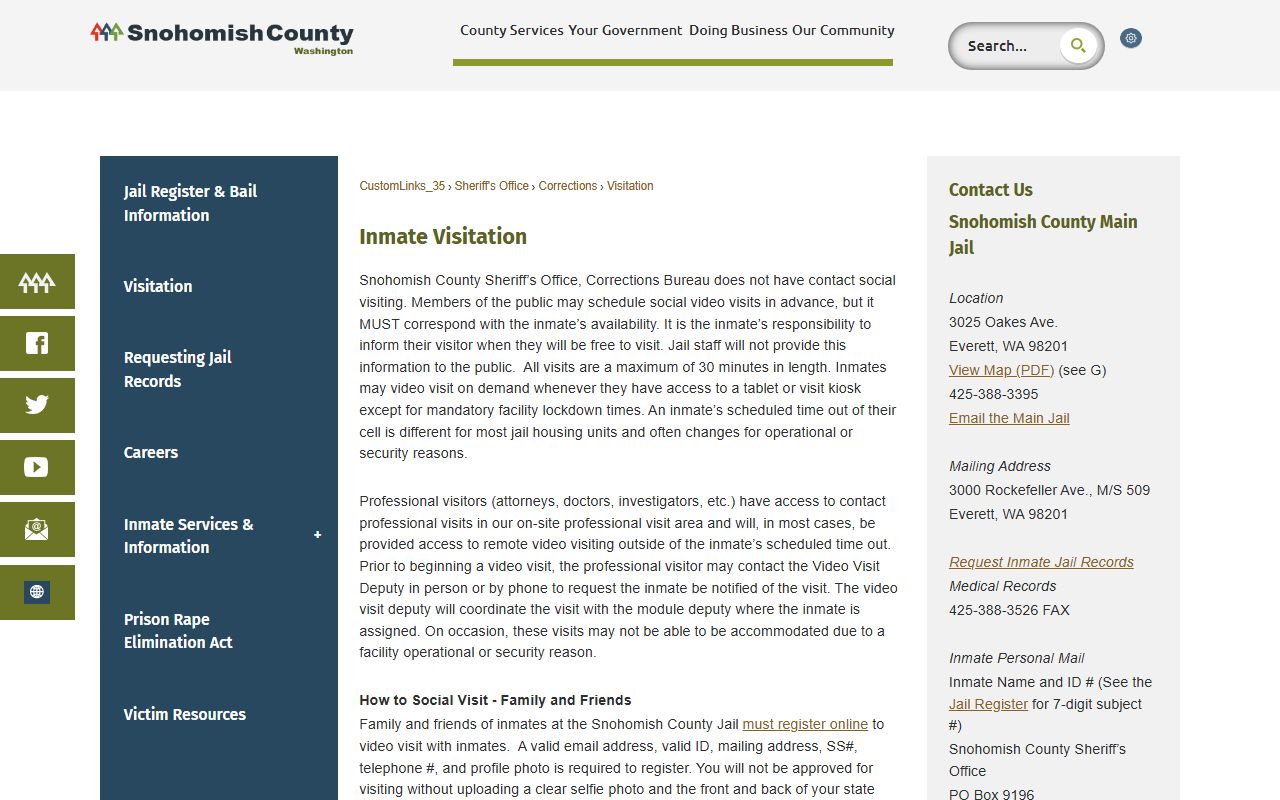
Lobby video visitation runs Monday through Friday, 8:30 a.m. to 4 p.m., and the jail reception lobby is open 8 a.m. to 4 p.m. on weekdays. High-security inmates who need escort are limited to set windows of 8:30 to 10 a.m. and 2 to 6 p.m. on weekdays. Professional visitors, such as attorneys, doctors, and social workers, may use on-site contact visits and remote video.
Mail follows strict handling. Personal mail is scanned and delivered to the inmate by tablet, and the original paper is destroyed. The county's inmate mail page spells out the address and the rules.
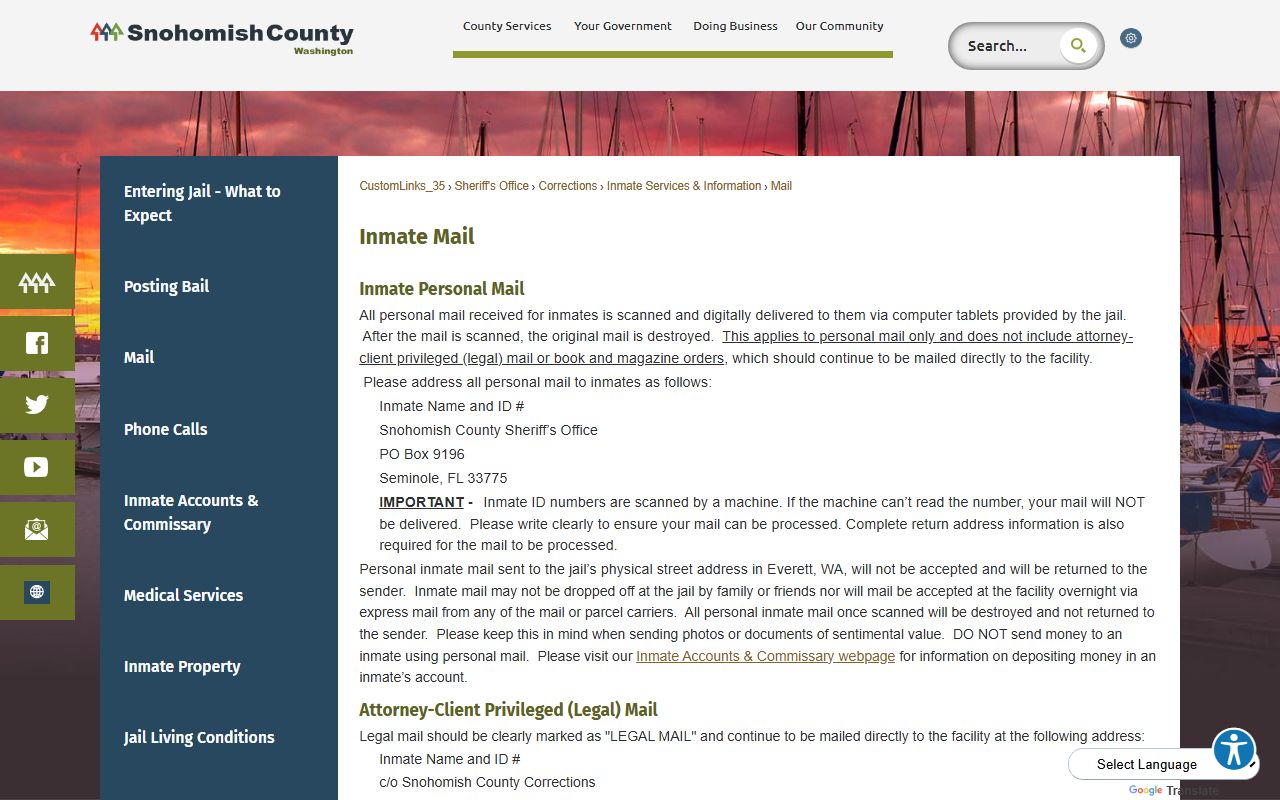
Personal mail goes to a Florida processing address: Inmate Name and ID number, Snohomish County Sheriff's Office, PO Box 9196, Seminole, FL 33775. The inmate ID must be clear or the scanner may fail. Mail sent to 3025 Oakes Ave. is not accepted and gets returned. Legal mail, marked LEGAL MAIL, goes straight to the facility at 3025 Oakes Ave., Everett, WA 98201. Care packages by mail are not accepted, though approved hygiene and writing items can be ordered through Access Securepak.
Money for an inmate runs through the commissary and account system, described on the inmate accounts and commissary page.
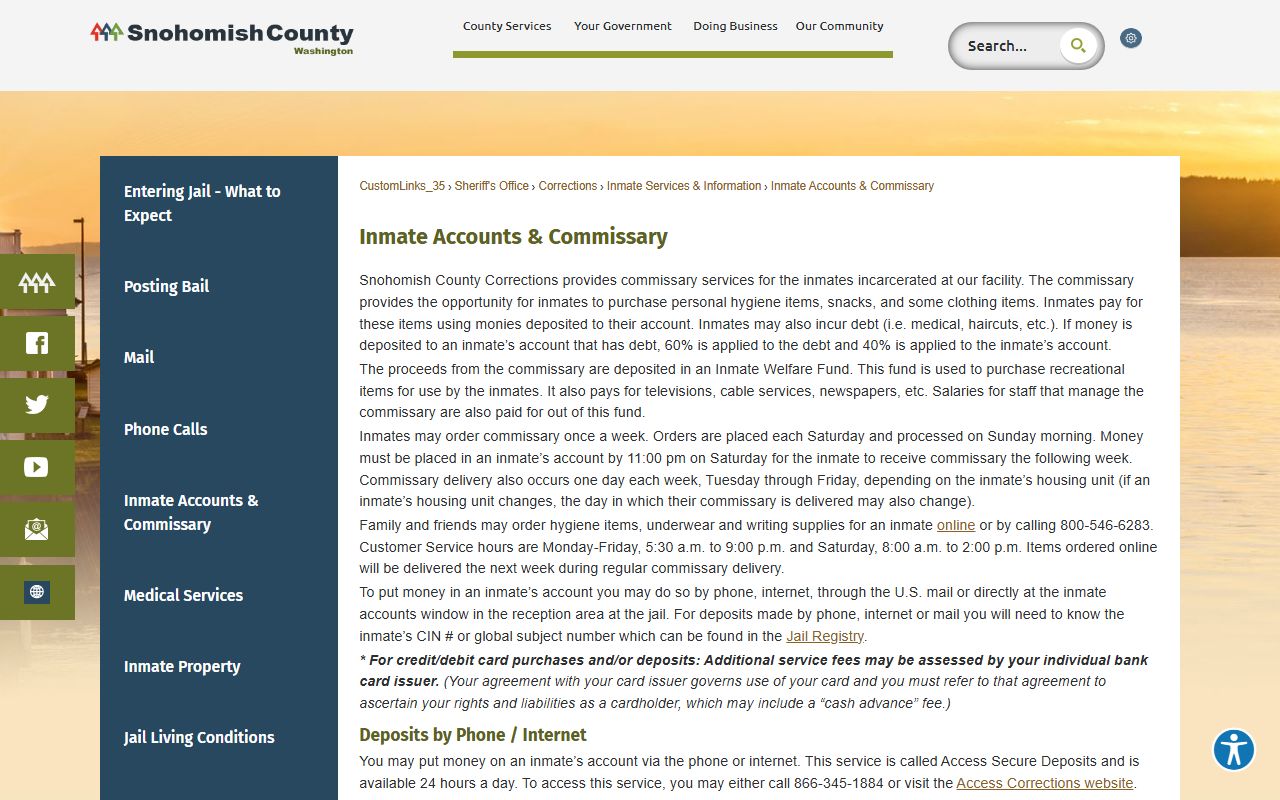
Commissary covers hygiene, snacks, and some clothing. When an inmate owes debt for things like medical care, a deposit splits 60 percent to debt and 40 percent to the account. Orders are placed Saturday and processed Sunday, so money must post by 11 p.m. Saturday for the next week. Phone and internet deposits use Access Secure Deposits, open 24/7 at 866-345-1884 or the Access Corrections website, and they need the 7-digit global subject number from the registry. In-person deposits take cash, cashier's checks, or money orders, but not personal checks.
Property held during custody follows its own policy, laid out on the inmate property page.
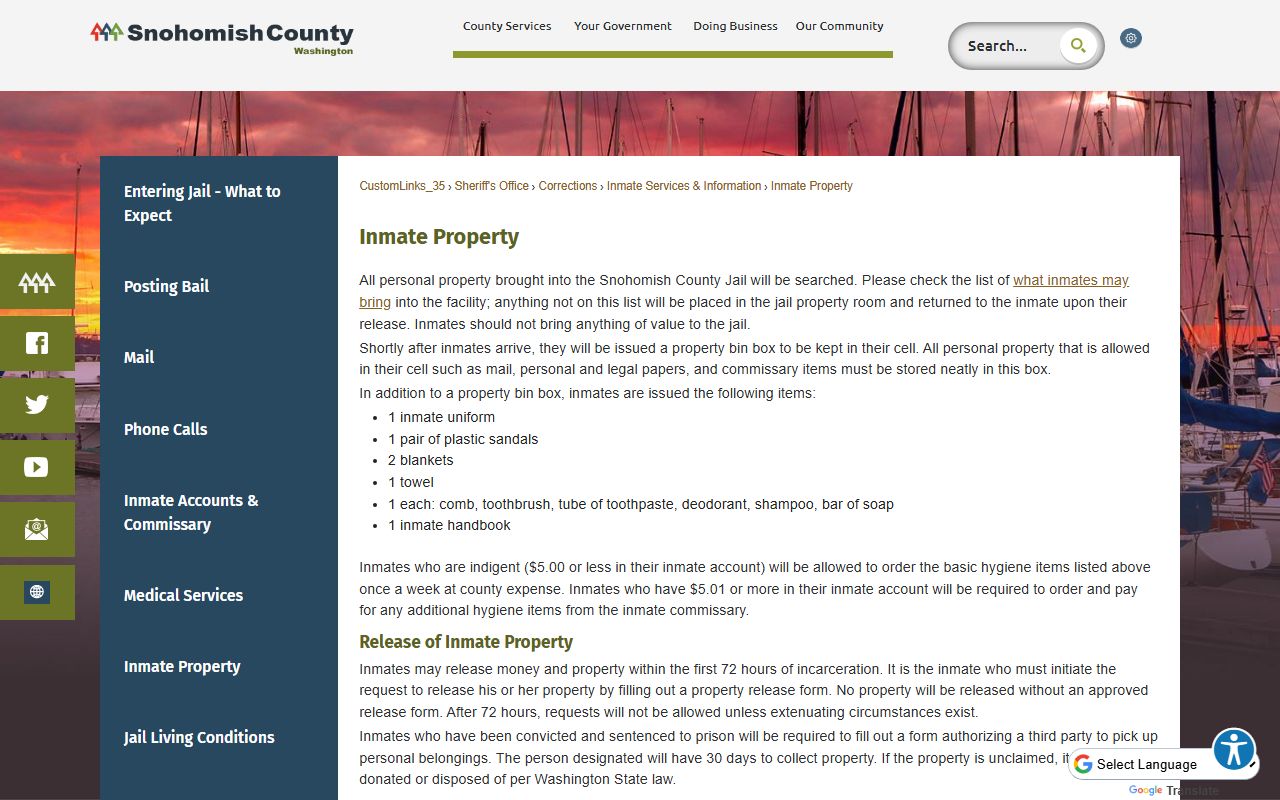
These operational rules do not produce a population count, but they shape the experience behind each record in the register. They also explain why the global subject number, drawn from the registry, threads through nearly every jail service.
Note: Contraband attempts in the visiting or secure area can lead to arrest and prosecution under RCW 9A.76, with penalties that depend on the conduct and prior history.
Searching for Snohomish County Inmate Records by Name
Population data answers how many; a name search answers who. Individual name lookups, custody status, and booking details are handled through the inmate records page rather than any population summary, since the register is built around named subjects and their global subject numbers.
Where the Data Comes From
Every figure on this topic traces back to a specific source, and a few of them simply do not exist as public county pages. The current, name-level data comes from the official NWS Jail Register kept by the Sheriff's Office Corrections Bureau. That register is the live source for who is held and on what charges.
Public access to jail record fields is grounded in state law. Washington's jail records statute, RCW 70.48.100, governs which booking and custody fields are open to the public, and the register reflects that framework. For broad jail trends that the county does not publish, BJS and Vera serve as the high-authority context sources, used for national and state framing only.
The honest summary: the live register exists and is public. Capacity, average daily population, demographic breakdowns, the pretrial versus sentenced split, and a five-year trend table were not located as official county publications. Those are flagged as gaps, not filled with invented numbers.
Note: The official jail site publishes current register data but not a public population trend dashboard, so long-run figures require sheriff budget reports or a records request.